PSQH Quick Poll 2026: Taking the Pulse of Patient Safety
By Jay Kumar
As part of PSQH’s celebration of Patient Safety Awareness Week, we decided to reach out to our readers with a few questions to find out the state of patient safety efforts in 2026. The survey had a total of 127 respondents.
Strengthening nursing’s role in quality and safety
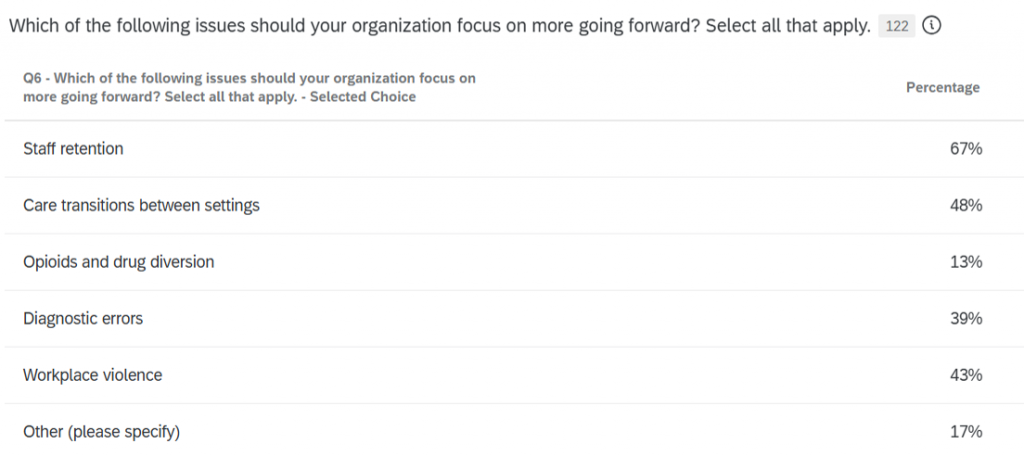
Asked about how their organizations can help strengthen nursing’s role in quality and patient safety efforts, 72% of respondents said more education and training is needed and 68% said mentoring from leadership was necessary. In addition, 35% said more leadership opportunities for nurses would be helpful and 30% called for increased emotional support. Other write-in responses included:
- Better staffing.
- Lead by example.
- Allowing nurses to lead.
- Studies showing why we do what we do to prove there is a reason for things. Full articles could be sent out or a synopsis with information on how to obtain full article. Increasing team conversation around safety and making it known that we are expected to call out questionable safety habits to improve our care and the safety of customers/staff.
- Increase awareness of culture of safety.
- A patient-centered approach to communicating expectations rather than rigid metrics. Anchor care requirements to patient outcomes, real-life examples.
- Not so much mentoring by leaders, but increased leader rounding and visibility. Model that you are committed to safety even though you aren’t at the bedside.
- Nurse retention.
- Protected time outside of clinical to do the work.
- Better data management workflows for all leaders.
- Holding staff accountable.
- Storytelling. Staff cannot relate, and do better when there is an example.
- Helping nurses understand their role and the impact they have on quality and safety efforts.
- Leadership buy-in and support for HRO principles, just culture, etc.
- It’s Leadership that needs the training and education. It is not so much emotional support as it is the opportunity to talk with psych professionals about what has occurred. The nurses need support. They see things that people in other fields would freak out over.
- Staffing.
- Opportunity to do the work. Nurse-to-patient ratios make it difficult for bedside teams to engage in quality and safety work.
Preparedness for the winter respiratory disease season
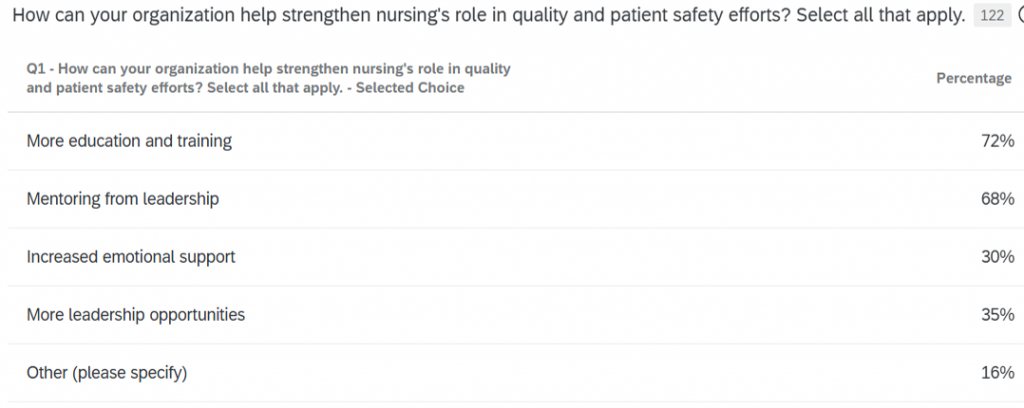
Asked about their organization’s preparedness for this winter’s respiratory disease season, 60% of respondents said they were very prepared while another 37% said they were somewhat prepared. Only 3% said they were not prepared.
Workplace violence
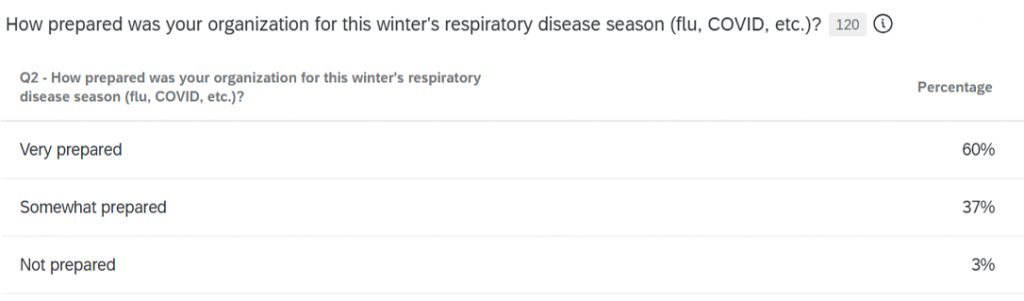
Workplace violence continues to be a major issue in healthcare. Asked about their level of concern regarding workplace violence, 37% said they were very concerned, 51% were somewhat concerned, and 13% were not concerned.
AI in healthcare
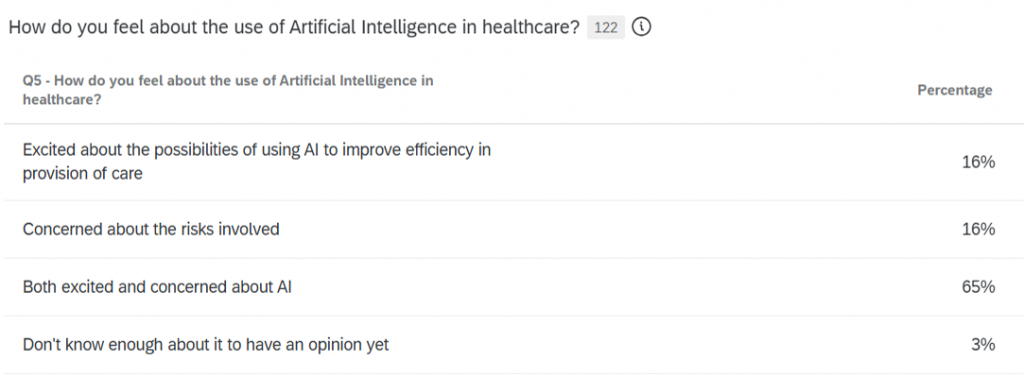
Asked about their feelings on the use of artificial intelligence (AI), 65% of respondents said they were both excited and concerned about AI, 16% were concerned about the risks involved, 16% were excited about the possibilities of using AI to improve efficiency in provision of care, and 3% said they didn’t know enough about AI to have an opinion yet.
Issues that need more focus
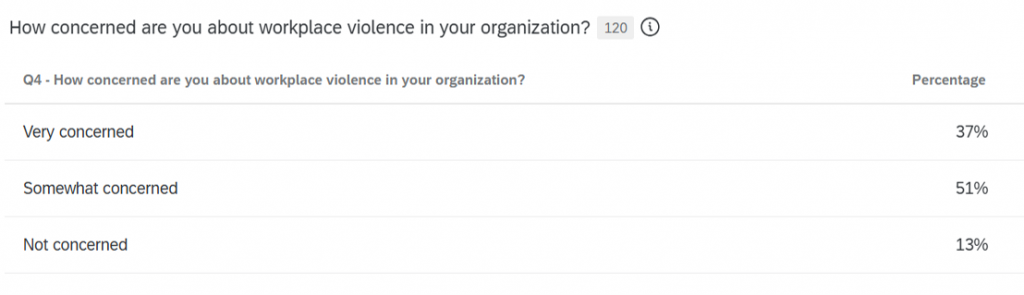
Asked which issues their organization needed to focus on more, 67% of respondents said staff retention, 48% said care transitions between settings, 43% said workplace violence, 39% said diagnostic errors, and 13% said opioids and drug diversion. Write-in responses included:
- Staff training.
- Disaster preparedness.
- Staff education and competency.
- Nurse-to-patient ratios.
- Becoming “mediocre” before jumping into going for a magnet status. Also need to support education/further education of staff and give incentive to do so. Most hospitals pay $1-$2 more per hour for a BSN degree, another couple dollars for a master’s degree and so on. It’s hard to pay back those loans when the pay is subpar. For instance, I’m at the top of the pay scale and I am living paycheck to paycheck more than I ever have before. We were paid last Friday and I have $4 in my account. I’m concerned about having gas to come to work next week. Financially, this hospital is killing the good workers it has.
- Instilling confidence in staff.
- A healthy workplace and a change in culture.
- Metric fatigue.
- Fall prevention.
- Psychological safety for patients AND staff.
- Effective nursing leaders and employee engagement.
- Higher leadership accountability and training.
- Educating patients in their care.
- All of the above but cautious about retention. Perhaps organizational retention, but today’s generation does not intent to stay for life. They are explorers. They will collect experiences and we need to learn to manage this and support it. There are endless opportunities now in healthcare. We created this, we can’t stop them. What we need to do is focus on recruitment and partner with those that want to explore so we can manage the business of healthcare without gaps in staffing.
- Staff training.