
IHI Forum: Panel Warns of the Health Implications of Compulsive Gambling
By Jay Kumar
A panel of experts urged attendees at the IHI Forum in Anaheim this week to start paying attention to a societal issue that could be the next health epidemic: Compulsive gambling addiction.
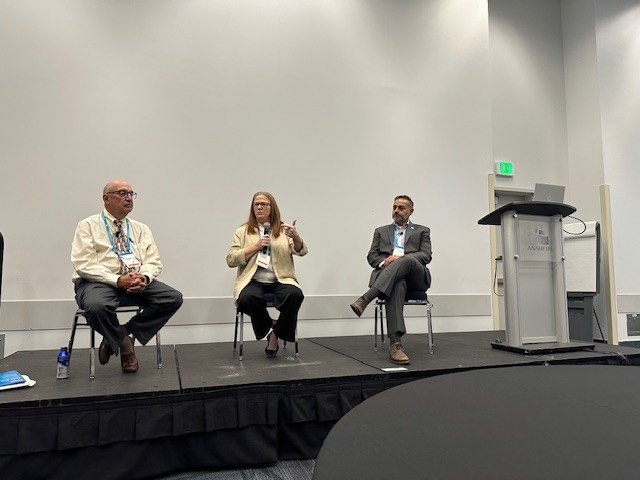
With the legalization and popularity of online sports betting, compulsive gambling is at an all-time high and the health impact will be enormous, said Heather Hugelmeyer, LCSW, Senior Director of Behavioral Health at Northwell Health’s Zucker Hillside Hospital in Queens, NY.
“When we talk about gambling, we’re looking at two roads: Pre-sports betting and post-sports betting,” she added. “The legalization of sports betting and online sports betting in now 30 states has changed the situation dramatically. Essentially, you’re in a situation now where you have a casino in your pocket for anybody. It’s easy access all the time.”
The constant barrage of advertising and the sports world’s embrace of gambling has created a younger generation of gambling addicts, Hugelmeyer said.
“We’re normalizing it because we have an entire generation that’s growing up where betting is connected to sports.”
In addition, younger children who play popular video games such as Fortnite and Minecraft are being primed for gambling through in-game “loot boxes” that encourage users to purchase or earn rewards, she said.
“It sets them up for the idea of betting,” said Hugelmeyer. “It’s within the games and it’s hitting the same dopamine rush in the parts of the brain that are priming them [for gambling].”
What this means for healthcare is there will be a potential generation of gambling addicts who will need treatment.
“We saw this as an industry with tobacco. We saw it as an industry with opiates. We are now watching it as an industry with gambling where we’re minimizing the potential negative impacts because there is enormous economic gain that comes out of promoting this,” Hugelmeyer said. “And we’re in a situation where we’re not being proactive to deal with the potential fallout, and honestly, we’re not even acknowledging the potential fallout.”
Included on the panel was Donald Reisfeld, a compulsive gambler who stopped gambling in 1979 with the help of the Gamblers Anonymous support group and now works to help others dealing with the addiction.
“What does a compulsive gambler look like?” he asked. “Compulsive gamblers suffer from an invisible illness. Other addictions—drugs and alcohol—tend to have physical traits. We look like anyone else except for the demons. Money is the fuel to destroy ourselves.”
Education is needed
Reisfeld, who founded the Reisfeld Family Foundation and works with Northwell Health to provide mental health support for gambling addicts, urged the healthcare professionals in the room to learn about the issue and educate their organizations.
“We need qualified professionals who can understand compulsive gambling and those who seek help,” he said. “I can’t tell you how many members say they went to see a counselor and the counselor had no understanding of what the compulsive gambler is up against.”
Dr. Sandeep Kapoor, VP of Emergency Medicine Addiction Services at Northwell Health, led the session and noted that many health professionals are unaware of the extent of the problem.
“It is definitely hidden from our point of view,” he said. “I never learned anything in medical school about this, I’m sure nursing colleagues in this room never learned anything about this, and frankly speaking, I’m sure social work and other colleagues have never heard anything about it.”
Hugelmeyer said the symptoms of gambling addiction look familiar.
“Gambling looks like other addictive disorders. You’re in a situation where there’s a loss of control that happens. Some of the symptoms that you’ll look for very much parallel not only addictive processes but other disease processes that we have that we talk about every day,” she said. “So you have a continuum. Diabetes has a continuum, heart disease has a continuum. When you talk about substance use disorder, there’s a continuum. You don’t wake up as a very progressed cocaine user. Gambling has a continuum. You have at-risk gambling where you see [that] one of the problem areas we look at is present.”
The problem is prevalent with college students, Hugelmeyer noted.
“Fairleigh Dickinson did a recent survey and 45% of the college-age population—that 18-30 demographic which is our quickest rising group in this area—had at least one area that meets problem criteria,” she said.
There’s also a middle range of gambler that is seeing the addiction begin to lead to financial issues, marital issues, or the desire to stop but not the will.
“Then there is a much more progressed use disorder, where somebody has potentially totally put themselves in financial ruin, has lost family, lost friends, are betting with money that they do not have. So taking out lines of credit, credit cards maybe, in other family members’ names,” said Hugelmeyer. “That desire, that compulsion to continue to bet is in the same parts of the brain that drive when we look at substance use.”
Reisfeld said the problem extends beyond just the individuals who are gambling.
“For every compulsive gambler, you affect seven other people,” including parents, spouses, and other family members, he added. “If you just take care of the compulsive gambler, you’re missing all these other people.”
Screening for gambling addiction
The key to providing help for gambling addicts is to provide screening for the issue, Hugelmeyer said.
“In healthcare, we have tons of opportunity and touchpoints and so we have an opportunity if we know this exists,” she said. “We talk to our patients about depression, we talk to our patients about anxiety, we screen for things all the time. And there are great evidence-based screening tools—two or three questions—just to screen. It will take 90 seconds to ask those three questions, but it could make the difference in terms of the ability to open a conversation and do an intervention when somebody’s in that at-risk stage versus then we’re looking at somebody way down the line.”
The questions ask the individual whether they’ve bet more money than they intended and whether they’ve been honest about the amount that they’ve bet in the last month. “If you screen positive, then it goes to somebody who has the ability to do a more advanced screening on that individual.”
Healthcare must step up to provide services for this population, said Hugelmeyer.
“If we’re talking about something that has the potential to ruin someone emotionally, financially, ultimately physically—the suicide risk of individuals who have a gambling addiction are twice that of somebody in the general population—we have an obligation to be on top of this. To be advocating, to be screening, to be a voice in this as we have with other social issues: gun violence and other times,” she said. “We need to get involved in this because it’s clear as day what is going to be coming downstream, and we’re really not prepared for it. We don’t have the treatment resources in place, healthcare professionals are not educated about this, there’s not universal screening protocols in place. Although evidence-based screening exists, it’s really not integrated into healthcare currently. I think we have obligation to do it because it’s part of wellness and us advocating for the health of our population.”
Next steps
In addition to screening, healthcare organizations need to engage with community partners such as high schools and colleges to raise awareness about the dangers of gambling addiction and that there are resources available for those who need them.
“We need to be that resource for the schools. We’ve been doing workshops for schools locally,” said Hugelmeyer.
Support is also necessary for parents and families of gamblers.
“We see a lot of the kids need it, but the parents are recognizing it as they’re watching the bank accounts drain or the credit cards go up,” she added. Even if the student isn’t necessarily willing to make that move yet, Hugelmeyer said the parents may be desperate for education on how to better prepare to communicate with their children on this issue.
Kapoor urged attendees of the session to go back to their organizations and find out what, if anything, is being done for those struggling with their relationship with gambling.
“Advocate for policy changes from the healthcare lens, seeing that this is going to impact the overall quality of life, as well as potential all the other things on that wheel of healthcare now with social determinants of health. Financial stability, food insecurity, all these things are impacted if money is going down the drain when it comes down to gambling and that’s when the advocacy comes. It’s really not advocating for things that are out of our control, it’s advocating for things that impact our constituents, which is their general health.
Hugelmeyer said the ultimate takeaway is that compulsive gambling is a topic that matters to healthcare.
“The road is clear. We just need to do something about it before disaster strikes.”